Guide
Three branches of government: who does what?
Learn the jobs of Congress, the President, and the federal courts, how checks and balances work, and what each civics test asks you to name.

newlycitizen
4 min read
Congress, the President, and the federal courts have different jobs. The Constitution divides federal power among them so that one part of government cannot easily take control of the whole system. Its first three articles set out those branches, as the National Archives explains.
For the civics test, start with each branch's name and job. Then connect those jobs to two ideas: separation of powers and checks and balances.
Each branch has a job
| Branch | Who belongs to it | Main job to remember |
|---|---|---|
| Legislative | Congress: the Senate and the House of Representatives | Makes federal laws |
| Executive | The President, with executive departments and agencies | Carries out and enforces federal laws |
| Judicial | The Supreme Court and other federal courts | Interprets laws and decides cases |
This is a study summary of the structure described by the National Archives, the Constitution's text, and USAGov's guide to the branches. Each branch has more responsibilities than this short table can show.
The President leads the executive branch. Congress has two chambers, so the Senate and the House are parts of the same branch. The Supreme Court is the highest federal court; the judicial branch also includes other federal courts. Keeping those groups together helps you avoid counting them as extra branches.
Why divide the power?
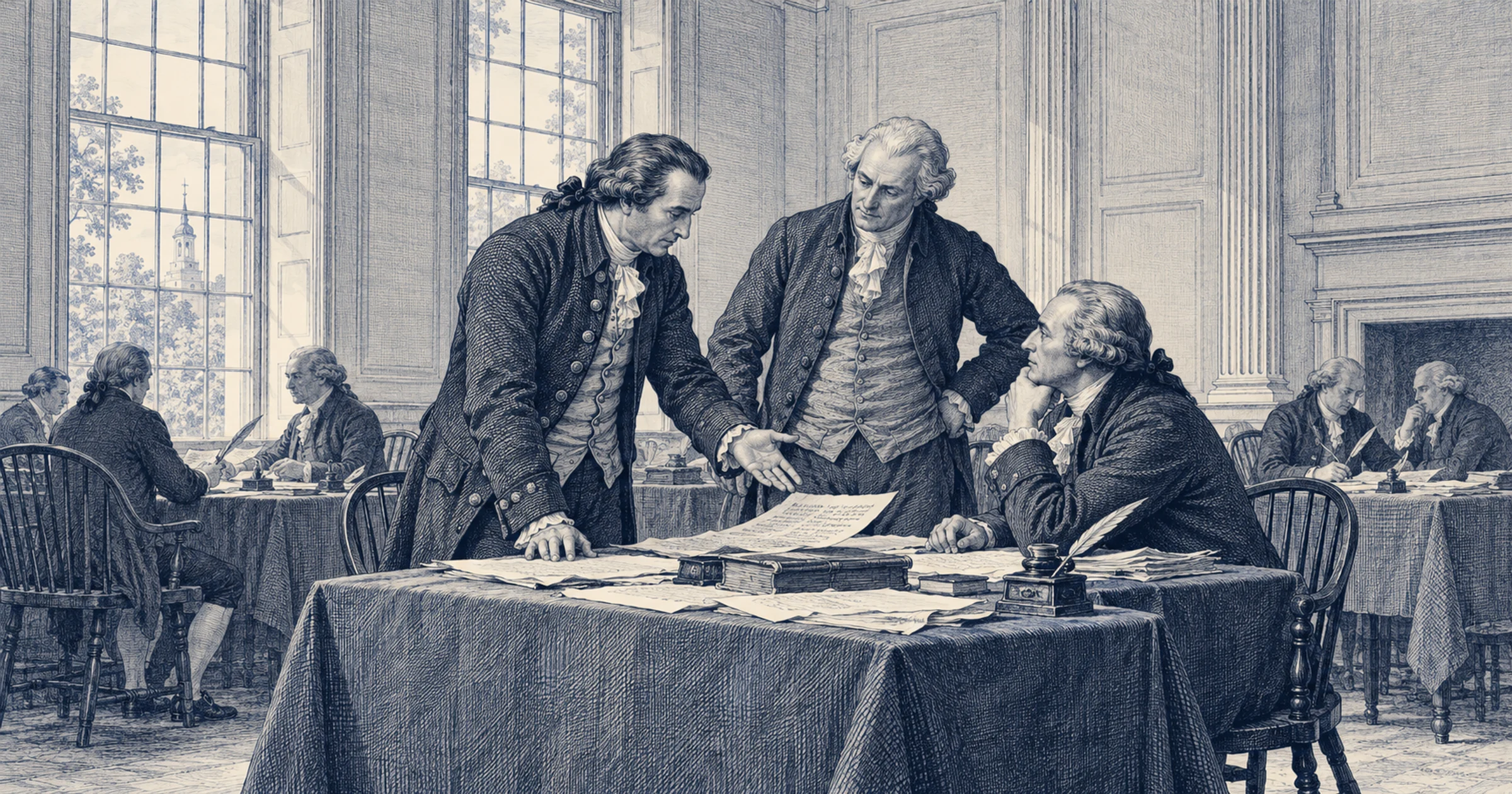
The delegates who met in Philadelphia in 1787 wrote the Constitution in the Assembly Room of the Pennsylvania State House, now called Independence Hall. The National Park Service's history of the room describes their debates about how the new government would work.
The resulting Constitution gives lawmaking power to Congress in Article I, executive power to the President in Article II, and judicial power to the federal courts in Article III. That division is called separation of powers. The National Archives' overview walks through the articles in that order.
The branches also have ways to limit one another. Those are checks and balances. The terms describe related parts of the same design: different responsibilities, with powers that let one branch restrain another.
Follow a bill through a disagreement
A veto makes that relationship easier to see. Suppose the House and Senate pass a bill and send it to the President. The President objects and returns it with a veto. Congress can still make the bill law by overriding that veto with a two-thirds vote in each chamber. The National Archives' explanation of vetoes describes this exchange of power.
Congress makes laws, but the President can check its work. The President can veto a bill, but Congress has a way to overcome the veto. Neither side has the only say.
The courts provide another check when they decide whether a law violates the Constitution. And the President nominates Supreme Court justices, while the Senate decides whether to confirm them. USAGov gives these examples of the branches affecting one another's actions.
What to practice for your test
The question numbers and the amount you need to name differ:
| Civics test | Question | What it asks you to do |
|---|---|---|
| 2008 | 13 | Name one branch or part of government |
| 2008 | 14 | Explain what keeps a branch from becoming too powerful |
| 2025 | 15 | Explain why there are three branches |
| 2025 | 16 | Name all three branches |
These are summaries of the questions in the 2008 USCIS list and the 2025 USCIS list. For 2008 question 14 and 2025 question 15, USCIS accepts either "checks and balances" or "separation of powers."
For 2008 question 13, naming Congress is one accepted response. For 2025 question 16, practice the complete set: legislative, executive, and judicial. You can use the jobs in the first table to remember the names, then check your answer against your test's official list.
Our test-version guide helps you choose the right list. For questions about people currently in office, check USCIS test updates before your interview.
Sources
Checked October 26, 2026. USCIS question numbers and answers were checked against indexed excerpts of official USCIS publications and the corresponding question banks. Direct access to the USCIS PDFs was blocked during this check. The other sources below were opened and read.
- Civics Questions and Answers, large print (2008 version), USCIS, questions 13 and 14.
- 128 Civics Questions and Answers (2025 version), USCIS, questions 15 and 16.
- The Constitution: What Does it Say?, National Archives.
- The Constitution of the United States: A Transcription, National Archives, Articles I, II and III.
- Branches of the U.S. government, USAGov.
- The Presidential Veto and Congressional Veto Override Process, National Archives.
- Assembly Room of Independence Hall, National Park Service.